


Dilijan is unlike anywhere else in Armenia. While the rest of the country opens wide into volcanic highlands and semi-arid plains, Dilijan folds you into forest — dense, layered oak and beech woodland that covers over 34,000 hectares of the Tavush region. Locals call it the Armenian Switzerland, and once you arrive, you understand why.
But Dilijan is more than scenery. It holds two of the finest medieval monasteries in the country, a beautifully preserved 19th-century merchant district, a clear mountain lake, and a quiet, unhurried pace that is rare to find so close to a capital city. It is the kind of place that rewards slowing down.
This guide covers everything you need to plan a visit — what to see, how to get there, when to go, where to eat, and the details that most travel sites leave out.
How to Get to Dilijan from Yerevan
Dilijan is approximately 110 km northeast of Yerevan and takes around 1.5 to 2 hours by car depending on traffic leaving the city and your route through the mountains.
The main road passes through Sevan, climbing over the Sevan Pass before descending into the forested valleys of the Tavush region. The road is well-paved and fully accessible year-round, though the mountain pass can be slow in winter conditions. The descent into Dilijan from the pass is one of the most scenic drives in Armenia — the moment the forest closes in around the road is the moment you know you’ve arrived somewhere different.
By private car or tour: This is the most comfortable and flexible option. A private day tour from Yerevan allows you to combine Dilijan with Sevan, Tsaghkadzor, or both — covering Armenia’s mountain north in a single long day.
By bus: Shared minibuses run from Yerevan’s Kilikia bus station throughout the day. Journey time is approximately 2 hours and fares are low. The station in Dilijan drops you in the center of town.
Parking: If you are driving, parking in Dilijan’s center is easy and free. The town is small and walkable from any central parking area.
Things to Do in Dilijan
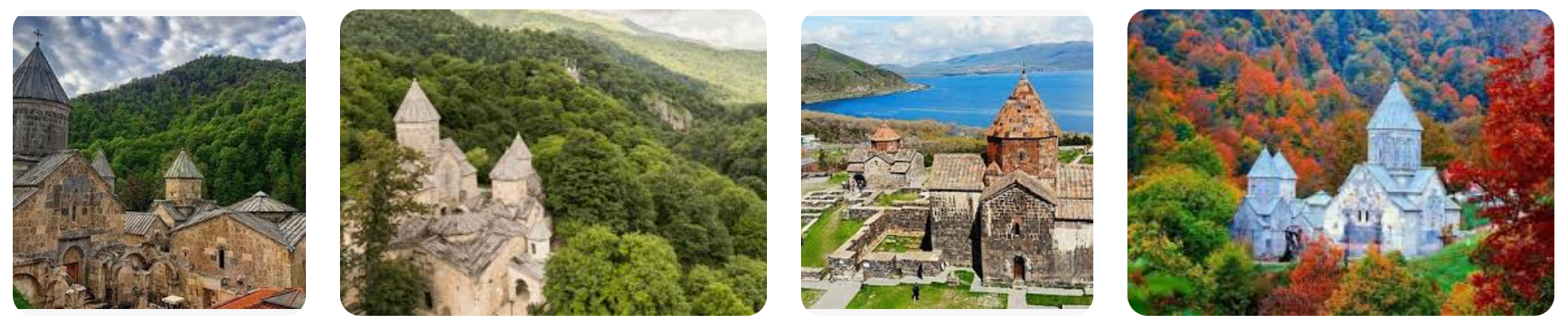
Haghartsin Monastery
Haghartsin is the reason many people make the trip to Dilijan, and it delivers. Founded in the 10th century and expanded through the 13th, the monastery complex sits deep in the forest roughly 18 km from town along a winding mountain road. The setting is extraordinary — the stone buildings emerge from the trees at the end of a valley, surrounded by hills on all sides, entirely cut off from any modern sight or sound.
The complex includes three churches — St. Astvatsatsin, St. Gregory, and St. Stepanos — along with a gavit (narthex), a refectory, and several khachkars carved directly into the rock face. The refectory in particular is worth taking your time with: its vaulted ceiling and carved reliefs are among the most refined examples of medieval Armenian craftsmanship in the country.
Haghartsin was restored between 2006 and 2012 with support from Dubai’s Sheikh Mohammed bin Rashid Al Maktoum, a project that generated some debate but unquestionably preserved buildings that were deteriorating badly. Entry is free. The road to the monastery is paved but narrow — take it slowly.
Goshavank Monastery
About 20 km from Dilijan, Goshavank is the second great monastery of the region and a place with an unusually specific historical significance. It was founded in 1188 by Mkhitar Gosh, the Armenian scholar and jurist whose legal code — the Datastanagirq — formed the basis for Armenian civil law and influenced legal systems across the medieval Caucasus. The monastery was built to house his school and scriptorium.
The exterior stonework at Goshavank is remarkable. The main church, St. Astvatsatsin, is covered in intricate carved decoration including some of the finest khachkars in Armenia — one of them, the White Khachkar, is considered a masterpiece of Armenian stone carving. Unlike Haghartsin’s forest setting, Goshavank sits on a hillside above the village of Gosh with open views across the valley. Entry is free.
Old Dilijan (Sharambeyan Street)
The historic quarter of Dilijan, centered on Sharambeyan Street, is one of the few places in Armenia where 19th-century merchant architecture has been carefully restored and brought back to life. The wooden-balconied houses, cobblestone lanes, and artisan workshops make it genuinely pleasant to walk — not a tourist recreation, but a working street with craft studios, a pottery workshop, a small local museum, and several cafés.
It takes around 30 to 45 minutes to walk through at a relaxed pace. The restored area is compact, but it connects to the broader old town if you want to continue exploring on foot.
Dilijan National Park and Lake Parz
Dilijan National Park covers 34,000 hectares and was established to protect one of the most significant remaining forest ecosystems in the South Caucasus. The park is home to bears, wolves, lynx, golden eagles, and over 150 species of birds. The forest itself — oak, beech, maple, hornbeam — is unlike anything else in Armenia.
Lake Parz (meaning “Clear Lake”) sits at 1,400 meters altitude in the northern part of the park. The lake is small but beautiful, surrounded by forest, and has become a popular activity hub with zip-lining across the water, boat rentals, and short hiking trails. It is a particularly good option if you are traveling with children. Entry to the lake area involves a small fee.
For hikers, the national park has several marked trails ranging from gentle forest walks to longer routes connecting to mountain ridges. The trail from Dilijan town up through the forest toward the Jukhtak Monastery ruins is one of the quieter, less-visited options.
Best Time to Visit Dilijan

Summer (June–August) is the most popular season. Temperatures in Dilijan are noticeably cooler than Yerevan — typically 8–10°C lower — making it a genuine escape from the capital’s heat. The forests are in full foliage, the roads are at their best, and all attractions are open and accessible. Expect more visitors, especially from Yerevan families on weekends.
Autumn (September–October) is arguably the finest time to visit. The beech and oak forest turns gold and amber across the hillsides, creating conditions that are genuinely stunning for photography and walking. Temperatures are comfortable, crowds thin out noticeably after mid-September, and the light in the afternoons is exceptional.
Spring (April–May) brings wildflowers and fresh greenery but also unpredictable weather, occasional road closures on the Sevan Pass, and some facilities that are still opening for the season. Worth it for experienced travelers who can be flexible.
Winter (November–March) is the least visited season but has its own character. The forest is bare and quiet, snow is common, and the drive from Sevan requires care. Most restaurants and some guesthouses remain open. If you want Haghartsin or Goshavank entirely to yourself, winter is when that becomes possible.
Where to Eat in Dilijan

Dilijan has a small but solid local restaurant scene built around forest ingredients — mushrooms, trout, herbs, and game feature heavily when in season.
Kchuch is the dish to order: a traditional Armenian stew cooked and served in a clay pot, typically containing lamb or pork with vegetables. Nearly every restaurant in the region serves it.
Several restaurants along the main road and near Sharambeyan Street offer reliable local food. Ask at your accommodation for wherever is currently considered the best — the scene shifts season to season. Prices in Dilijan are noticeably lower than Yerevan for comparable quality.
If you are combining Dilijan with a visit to Lake Sevan on the same day, consider having lunch at the lake (the fresh ishkhan trout there is genuinely exceptional) and treating Dilijan as an afternoon stop with a coffee or snack in the old quarter. Most popular restaurants in Dilijan: Kchuch Restaurant, Ker u Sus restaurant, Diljazz hotel and restaurant, Getap, Karahunj, Tava restaurant.
How Long to Spend in Dilijan

Half day: Enough for Sharambeyan Street, one monastery (Haghartsin or Goshavank), and a coffee in town. This is the typical allocation when combining with Sevan or Tsaghkadzor on a day tour from Yerevan.
Full day: Allows you to visit both monasteries, walk Lake Parz, and spend genuine time in the national park — the right amount for anyone who wants to actually feel the place rather than just pass through it.
Overnight or two nights: Unlocks early morning monastery visits before any other visitors arrive, longer hikes, and the kind of slow pace that Dilijan is actually designed for. Several good guesthouses operate in the town and surrounding villages.
Insider Tips from a Local Guide
Go to Haghartsin early or late. The monastery is at its best in the first hour after opening or in the late afternoon when tour groups have moved on. In that window you can have the complex almost entirely to yourself.
The road between Sevan and Dilijan is worth taking slowly. The mountain pass at the boundary of the Gegharkunik and Tavush regions offers views in both directions that most visitors drive through too quickly. Pull over once or twice.
Dilijan’s forest trails are underused. Most visitors stick to the main attractions, which means the national park’s hiking routes are genuinely quiet. Even a 45-minute walk into the forest from the edge of town takes you somewhere that feels completely removed from tourism.
Book a private tour if logistics matter to you. The monasteries are spread 15–20 km apart from town in different directions. Without a car, reaching both on the same day requires careful planning. A private guide also adds context that makes Haghartsin and Goshavank significantly more meaningful — these are not just beautiful buildings but specific chapters in Armenian history.
Visiting Dilijan as Part of a Day Tour from Yerevan
Dilijan combines naturally with Lake Sevan and Tsaghkadzor in a single long day — covering three of Armenia’s most distinct mountain landscapes in one route. The drive between all three moves through consistently beautiful scenery and each destination has a different character: the alpine resort town, the vast highland lake, the deep forest.
If you are based in Yerevan and want to see the best of Armenia’s north in a day, this is the route that makes most sense. Private tours can be adjusted to your pace, with additional stops along the way.
→ See our private day tour covering Tsaghkadzor, Lake Sevan & Dilijan



Comment (0)