


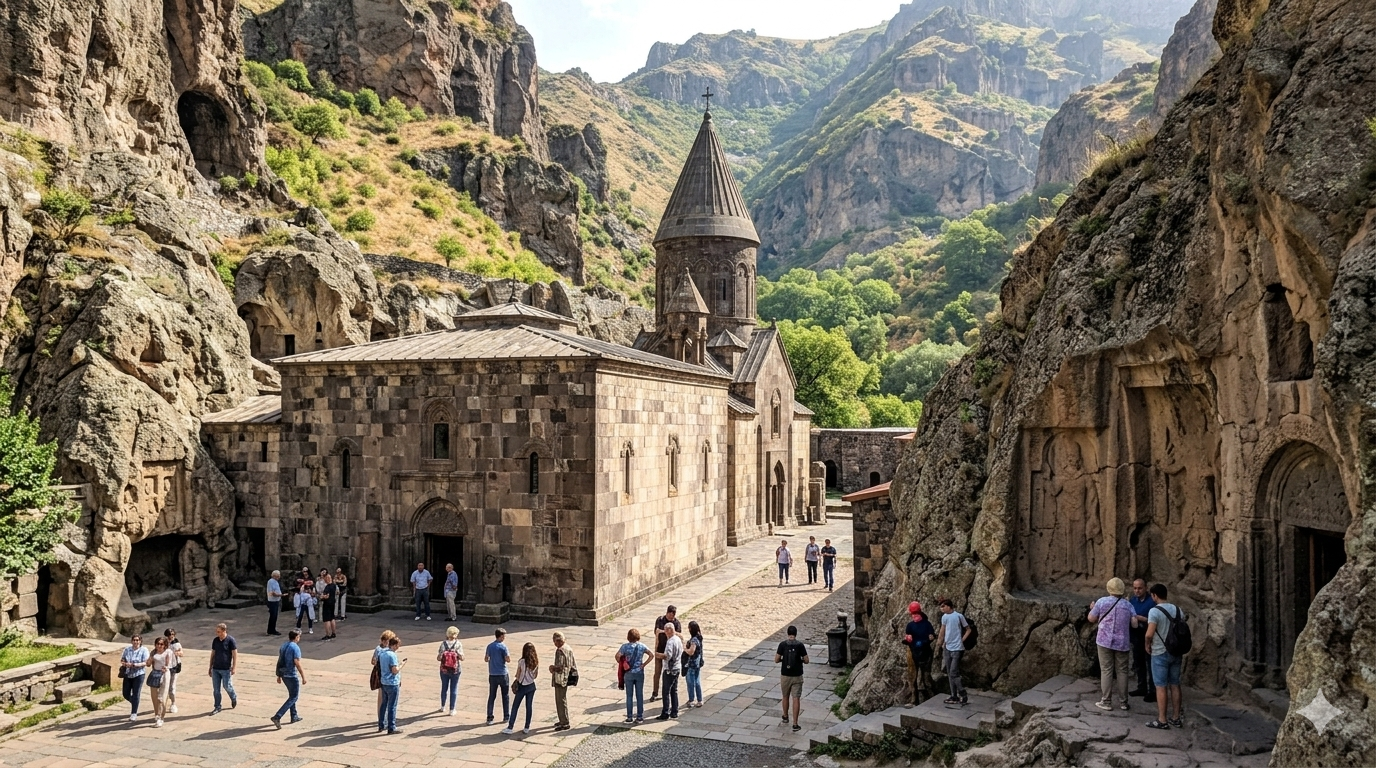
This is the day trip that most visitors to Armenia do first — and the one they remember longest. Within 30 km of Yerevan you will find a perfectly preserved Hellenistic pagan temple, a cave monastery carved directly into a cliff face, a gorge lined with natural basalt columns that look engineered, and a viewpoint where a Soviet poet wrote his most famous lines about Armenia. All of it in half a day, with a proper Armenian lunch in between.
Here is everything you need to plan the trip well.
How to Get to Garni from Yerevan
By private car or tour: The easiest option. A private tour from Yerevan handles all logistics and typically combines Garni, the Symphony of Stones, the Arch of Charents, and Geghard in a single smooth route. This is worth considering particularly because Geghard is a dead-end road — taxis are scarce on the return.
By public transport: Bus No. 266 runs from Gai Bus Station in Yerevan (not the main bus station — use Google Maps and search “real Gai Bus Station”) directly to Garni village, roughly every hour. From Garni to Geghard you will need a taxi — around 3,000–4,000 AMD for a drop-off and wait. There is no public transport connecting the two.
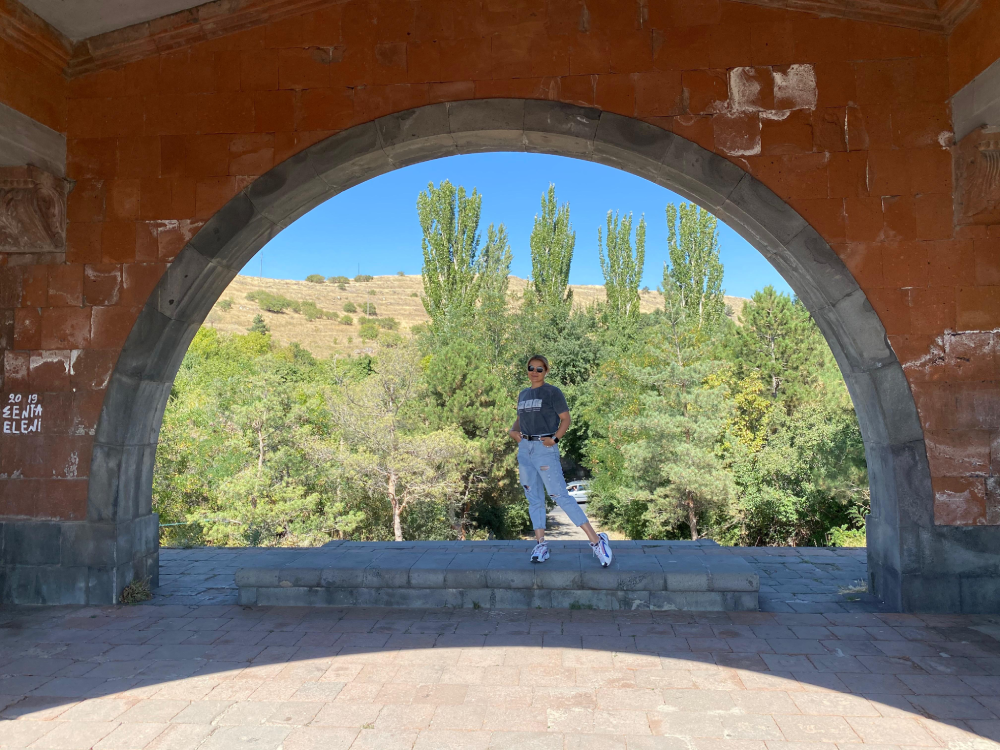
The Arch of Charents
Before reaching Garni, the road passes through a stone archway framing one of Armenia’s most celebrated views: Mount Ararat rising above the Ararat Valley, framed perfectly in the arch’s opening.
The arch was built in 1957 and takes its name from Yeghishe Charents, the great Armenian poet of the early Soviet period, who wrote: “Oh, those who have not seen Ararat, come and look.” The quote is inscribed on the arch itself. For Armenians, Ararat is a deeply loaded symbol — the mountain sits in Turkey and has been out of reach since 1921, visible every clear day from Yerevan but unreachable. Standing at the arch with the mountain filling the gap in the stonework, the emotional weight of that is easy to understand even for a visitor.
The stop takes about 15–20 minutes. Parking is roadside and free. The view is best in the morning on a clear day before haze builds up.
Garni Temple
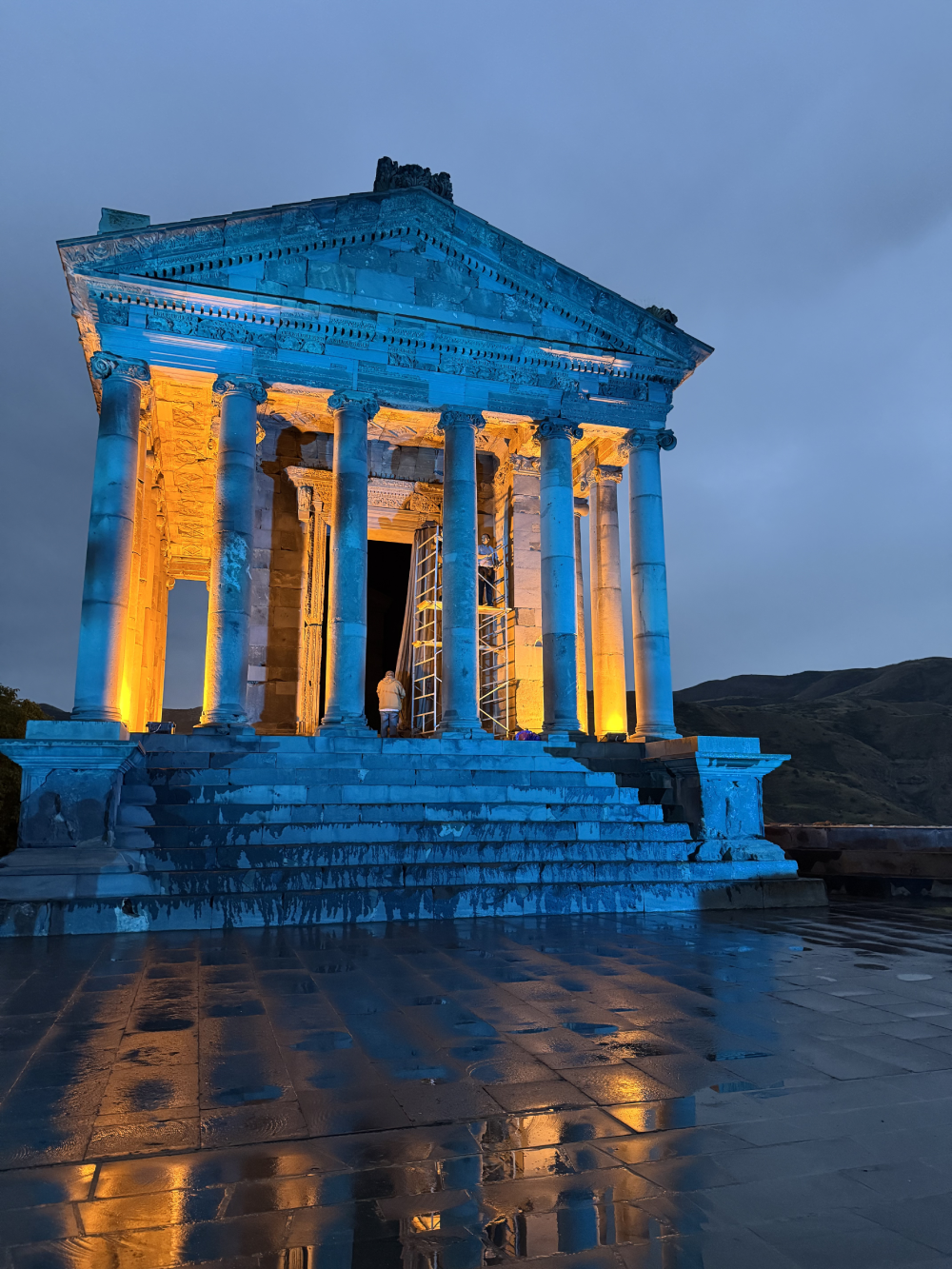
Garni Temple is the only standing Greco-Roman style temple in the entire South Caucasus, built in 77 AD by the Armenian King Tiridates I and dedicated to the sun god Mihr. It is built from large, precisely fitted basalt blocks with 24 Ionic columns — a number believed to represent the 24 hours of the day.
What makes Garni remarkable is its survival. When Armenia adopted Christianity in 301 AD, pagan structures across the country were demolished. Garni was spared, reportedly because the king’s sister persuaded him to preserve it as a royal summer residence. It stood for another 13 centuries before a major earthquake in 1679 brought it down. The temple was painstakingly reconstructed using the original stones between 1969 and 1975 — a process that used photographs, written accounts, and the excavated debris to reassemble it almost entirely from original material.
On the same grounds you will find the remains of a 4th-century church built directly over a pagan bathhouse (the mosaic floor is partially visible), a medieval Armenian church, and a beautiful carved fountain. Allow at least 45 minutes to walk the whole complex.
Entry fee: 1,500 AMD per Number of People, 750 AMD for students. This is one of the very few paid sites in Armenia. Parking: 100 AMD, limited spaces near the entrance — park along the road 200 metres back if the lot is full on busy weekends.
Best time to visit: Weekday mornings. Weekends bring large groups and the site can feel crowded by midday.
Symphony of Stones
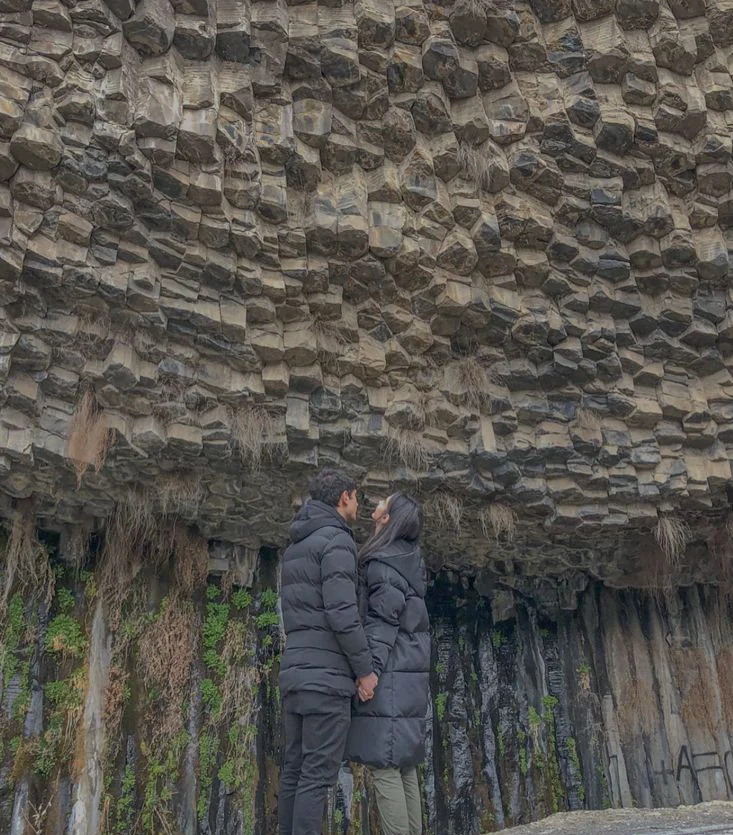
A short drive below Garni Temple, down into the Azat River gorge, is one of the most visually striking natural formations in Armenia: the Symphony of Stones, a wall of perfectly hexagonal basalt columns rising vertically from the canyon floor, formed by slow volcanic cooling millions of years ago.
The columns are remarkably regular — some up to 50 metres tall — and the effect of hundreds of them packed tightly together against the gorge wall is genuinely arresting. The name comes from the way they resemble a giant pipe organ. The gorge itself, with the Azat River running below, is beautiful in its own right.
The walk from the ticket point down to the gorge takes about 10 minutes. The view point looking up at the columns is the payoff. Allow 20–30 minutes total.
Entry fee: 300 AMD per person.
Practical note: The path down is steep and can be slippery after rain. Wear shoes with grip if visiting in autumn or after wet weather.
Where to Eat in Garni: 7 Qar and Macramé
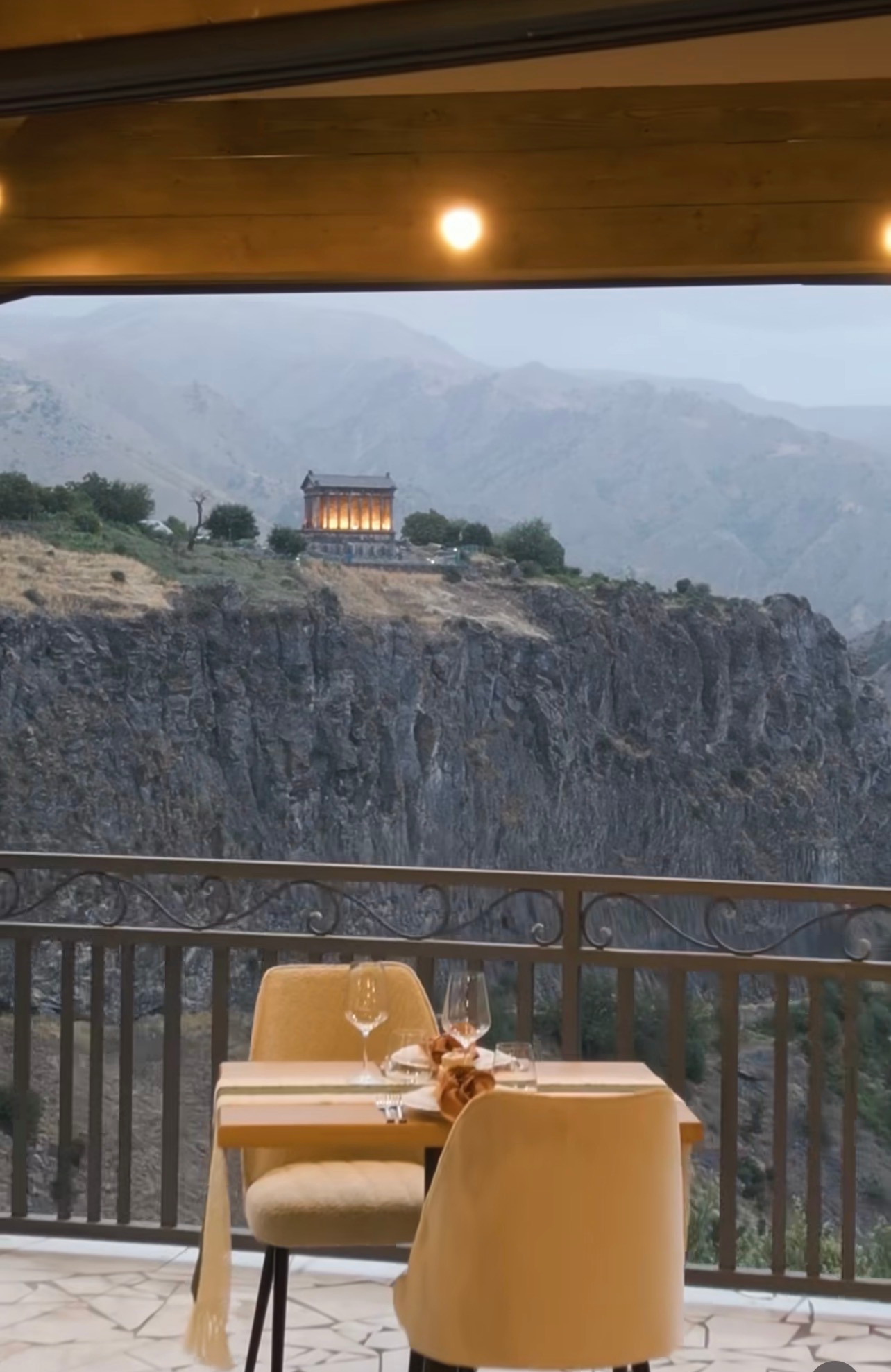
Garni has two restaurants that genuinely stand out — both for the food and for their location overlooking the temple and gorge. This is one of the few places in Armenia where a lunch stop is as much a part of the day as the sights themselves.
7 Qar Restaurant
7 Qar (“7 Stones”) is set directly above the Garni gorge with a terrace overlooking the temple below — quite possibly the best restaurant view in Armenia. The kitchen works with organically grown produce, much of it from the surrounding land, and centres the menu around Armenian grilled meat (khorovats), fresh trout, dolma, and homemade bread baked in a traditional tonir right in front of you.
The drunken beef loin is the signature dish and the one most regulars come back for. The trout is equally reliable. Lavash arrives fresh from the tonir — watch it being slapped onto the inside wall of the oven and pulled out minutes later. This alone is worth pausing for.
Address: 30 Grigor Zohrap St., Garni village. Hours: 11:00–22:00 daily. Reservation recommended on weekends (+374 77 777967 / info@7qar.am). Expect to spend around 6,000–12,000 AMD per person for a full meal with drinks.
Macramé Restaurant
Macramé is Garni’s other standout — a more intimate space with a carefully considered interior and a menu that puts Armenian ingredients through a slightly more contemporary lens. If 7 Qar is the feast-with-a-view option, Macramé leans toward a quieter, more composed dining experience.
It is particularly popular with visitors who want something between a full Armenian feast and a lighter lunch. The setting is atmospheric and the staff are attentive. Worth booking ahead on weekends.
Both restaurants are genuine locals’ favourites, not tourist traps — an important distinction in a village that sees significant visitor traffic.
Geghard Monastery
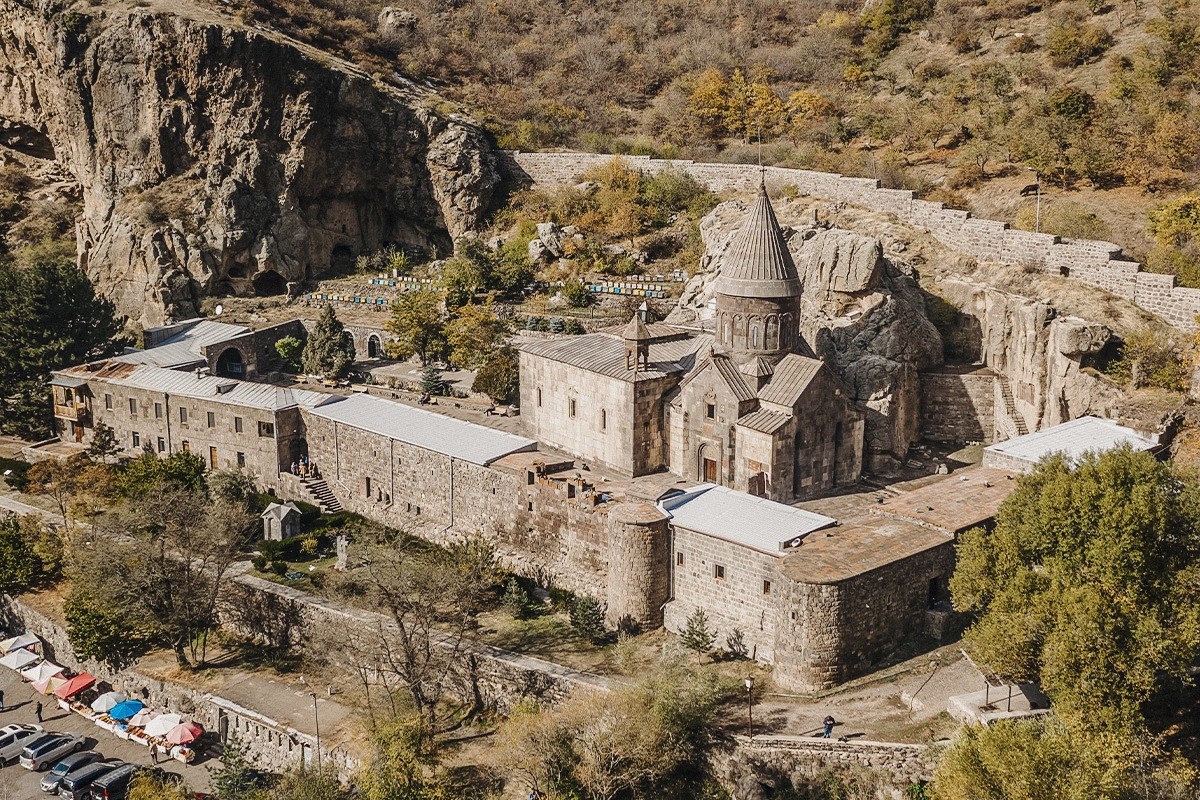
Geghard is a UNESCO World Heritage Site and one of the most extraordinary architectural achievements in medieval Armenia. The monastery is built partly as freestanding structures and partly carved directly into the vertical cliff face of the Azat River gorge, the two elements blending so naturally with the rock that the line between construction and nature is genuinely hard to find.
Founded in the 4th century by Gregory the Illuminator at a site where a sacred spring flowed directly from the rock, the complex takes its current name — Geghard, meaning “spear” — from the Holy Lance said to have pierced Christ at the Crucifixion, brought to Armenia by the Apostle Thaddeus in the 1st century. The spear was kept here until the 13th century and is now in the treasury at Etchmiadzin Cathedral.
The main church, the Katoghike, was built in 1215 under the patronage of the Zakarian noble family, whose tomb chamber is carved into the rock at the rear of the complex. Above it, reached by steep stone stairs cut into the cliff, are the second and third cave chambers — the gavit (narthex) and the vaulted burial chamber of the Proshyan princes, with its famous carved lion-eagle relief and stalactite-style ceiling decoration.
The acoustics inside the cave chambers are remarkable — Armenian spiritual chants performed here create a resonance that feels completely different from any church interior. If you encounter a choir singing during your visit, stop and stay for it. Even on an ordinary weekday, local women sometimes sing in the outer chamber.
Entry: Free. Hours: Open daily from approximately 9:00. Parking: Small lot at the end of the road, 200 AMD. The monastery is at the end of a dead-end valley — no through traffic, no noise, no distraction.
Practical note: The interior is dark. Give your eyes a moment to adjust before moving through the cave chambers. Dress modestly — this is an active place of worship. Head coverings are provided at the entrance for women.
Suggested Day Itinerary
09:00 — Depart Yerevan
09:30 — Arch of Charents (20 min)
10:00 — Symphony of Stones, Garni Gorge (30 min)
10:45 — Garni Temple (45–60 min)
12:15 — Lunch at 7 Qar or Macramé (1.5 hours)
14:00 — Drive to Geghard (20 min)
14:20 — Geghard Monastery (60–75 min)
15:45 — Return to Yerevan (45 min)
This leaves the afternoon free in Yerevan. The route flows naturally without backtracking.
Insider Tips from a Local Guide
The Arch of Charents is best before 10:00. Ararat tends to be clearer in the morning before heat haze develops over the valley. By afternoon on hot days the mountain can almost disappear.
Geghard before noon is a different experience. The light enters the open roof of the cave chambers in the morning, creating visible shafts through the incense smoke. By afternoon the interior is darker and the atmosphere changes. Worth arriving earlier if you have flexibility.
Don’t skip the upper cave levels at Geghard. Most visitors see the main church and leave. The carved chambers above — particularly the Proshyan gavit — are the architectural heart of the place. Take the stone stairs on the left of the main church up to the second level.
7 Qar on weekends fills up. Book a table the day before if visiting Saturday or Sunday. The terrace fills quickly by 13:00 and you don’t want to be waiting for a table with that view in front of you.
The gorge path at Symphony of Stones is short but steep. If you’re traveling with elderly guests or small children, the main viewpoint at the top still gives a clear sight of the columns without the descent.
Visiting as Part of a Private Tour from Yerevan
The Garni–Geghard route is the most requested private day tour from Yerevan — and the one that delivers consistently regardless of season. The sights are accessible year-round, the drive is beautiful, and a good guide transforms both Garni and Geghard from impressive ruins into specific, living chapters of Armenian history.
Our private tours cover the Arch of Charents, Symphony of Stones, Garni Temple, and Geghard Monastery with an English or Russian-speaking guide and comfortable private vehicle, adapted to your pace.
→ See our private Garni & Geghard day tour from Yerevan




Узнайте [url=https://movingwaldo.ru/raschet-perevozki-gruza]калькулятор перевозки[/url] на нашем сайте и планируйте выгодные перевозки без лишних затрат.
Стандартные типы грузов наиболее выгодны с финансовой точки зрения.
Fantastic! This site has the greatest hardcore anal videos!
The girls get their asses stretched and the quality is perfect.
At last found a site with true brutal anal action. Gaping and
messy creampies.
Best anal porn collection I’ve found. The scenes are so intense and the girls look amazing.
These hardcore anal clips are addictive. Passionate and super
filthy. Streaming works perfectly.
Wild anal action! Tight asses getting stretched in the filthiest way.
Strongly recommended! Absolutely addicted!