


Some places in Armenia feel less like tourist attractions and more like landscapes from a different century. Khor Virap and Noravank belong to that category. One stands in the middle of the Ararat Plain beneath Armenia’s most iconic mountain. The other hides deep inside a red-rock canyon where cliffs rise almost vertically above the monastery walls.
Together, they form one of the most popular day trips from Yerevan, combining history, landscapes, monasteries, wine, and one of the most scenic roads in the country.
This guide covers everything travelers usually search for before visiting: how to get there, prices, what to see, whether it is worth adding Areni wine tasting, best photo spots, travel tips, and how to plan the route in 2026.
Why Visit Khor Virap and Noravank?
Because this route shows several completely different sides of Armenia in one day.
You start in the wide Ararat Valley with views toward Mount Ararat and the Turkish border. Then the road slowly changes, vineyards appear, the mountains become sharper, and eventually the landscape turns into the dramatic red canyon of Noravank.
The route combines:
Armenia’s most famous Mount Ararat viewpoint
One of the country’s most important religious sites
Medieval monasteries
Scenic mountain roads
Wine region villages
Ancient cave complexes
Traditional Armenian food and local wine
For many travelers, this becomes their favorite day trip from Yerevan.
Where Are Khor Virap and Noravank Located?
Khor Virap
Khor Virap is located in the Ararat Province, close to the Armenian-Turkish border, around 45 kilometers from Yerevan.
The monastery sits on a hill overlooking the Ararat Plain and is famous for its direct view of Mount Ararat.
Noravank
Noravank is located about 120 kilometers southeast of Yerevan, inside a narrow red-rock canyon in the Vayots Dzor region.
The road leading to the monastery is considered one of the most scenic drives in Armenia.
How to get there from Yerevan?
A full trip with stops usually takes 8–10 hours.
The route runs south from Yerevan through the Ararat Valley, then southeast into the Vayots Dzor region. Total driving distance for the round trip is approximately 250 km.
Khor Virap is 45 km south of Yerevan — about 45–55 minutes by car depending on traffic leaving the city.
Noravank is approximately 122 km from Yerevan and about 1.5 hours by car from Khor Virap — the drive includes a particularly beautiful section through the Amaghu River gorge, the red-walled canyon that surrounds the monastery.
By private car or tour: The only practical way to see both sites comfortably in one day. Public transport options are limited and do not connect the two sites directly. A private tour handles all logistics, adds meaningful context to both sites, and allows flexibility — Areni wine tasting and the cave can be added on the return.
Khor Virap Monastery: Armenia’s Most Famous View

The name Khor Virap means “deep dungeon” in Armenian, and that is exactly what this place was before it became one of the holiest sites in the country.
Originally built as a royal prison around 180 BC by King Artashes — founder of the ancient Armenian capital of Artashat, whose ruins lie just north of the monastery — Khor Virap was the place reserved for enemies of the state. The prisoners included condemned men, alleged traitors, and one figure whose imprisonment here would change the course of Armenian history.
That figure was Gregory the Illuminator. An advisor to King Tiridates III, Gregory was thrown into the dungeon in approximately 287 AD for refusing to renounce Christianity and worship the pagan goddess Anahit. According to tradition, he survived for 13 years in the pit — fed secretly by a Christian widow from a nearby village who lowered bread to him. When King Tiridates fell gravely ill, his sister had a vision that only Gregory could cure him. The prisoner was released, healed the king, and converted him to Christianity. In 301 AD, Armenia became the first nation in the world to adopt Christianity as its state religion. The dungeon became a shrine.
A chapel was built on the site in the 5th century. The current monastery complex — the main Church of Surb Astvatsatsin (Holy Mother of God) and the smaller Chapel of Surb Gevorg — dates primarily from the 17th century, rebuilt after the devastating 1679 earthquake that destroyed much of the Ararat Valley. The fortress walls surrounding the complex are among the few elements to survive from earlier periods.
This is a tip most guides leave out: the best photograph of Khor Virap with Mount Ararat is taken from the road, not from inside the complex.
What to See?
The dungeon. Inside the Chapel of Surb Gevorg, a narrow iron ladder descends approximately 6 metres into the rock — this is the pit where Gregory was held. The chamber at the bottom is small, dark, and low-ceilinged. There are actually two pits accessible at Khor Virap; the smaller one, directly beneath the chapel, is the one traditionally identified as Gregory’s cell. It requires some physical agility to descend and is not suitable for those with claustrophobia. It is, however, one of the most viscerally powerful places in Armenia — standing in the dark at the bottom of a 2,000-year-old prison pit where a saint spent 13 years is an experience that stays with you.
The main church. The Church of Surb Astvatsatsin is modest in size but significant as an active place of pilgrimage. Inside, candles burn constantly, pilgrims leave offerings, and on important feast days the complex fills with worshippers from across Armenia. The sundial on the church’s southern wall is original to the 17th century.
The viewpoint. Walk north from the main entrance, past the monastic cells and through the far gate, to the hill above the complex where the Armenian flag flies. This elevated position gives you the clearest, most unobstructed view of Mount Ararat — the two summits of Greater Ararat (5,137m) and Lesser Ararat (3,925m) filling the southern sky, with the Araks River and the Turkish border visible in the flat land below. On a clear morning this is overwhelming.
Entry: Free. Hours: Open daily 09:00–18:00 (until 20:00 in summer). Dress code: Modest dress required — cover shoulders and knees. Head scarves are provided for women at the entrance. Time needed: 45–60 minutes.
Noravank: Armenia’s Red Canyon Monastery

The Setting
Nothing quite prepares you for the approach to Noravank. The road turns off the main highway and enters the Amaghu River gorge — a narrow canyon with vertical walls of deeply striated red and orange limestone rising on both sides. The canyon tightens as you drive deeper in, the cliffs turning more intensely coloured, until the road ends in a small parking area and the monastery appears at the far end, pressed up against the canyon wall.
The red cliffs are not background scenery — they are part of the experience. At golden hour and sunset, the stone glows in a way that is difficult to photograph accurately and even more difficult to describe. This is one of the places in Armenia where photography is both completely futile and completely irresistible.
The History
Noravank — “New Monastery” in Armenian — was founded in 1105 by Bishop Hovhannes. It grew into a major spiritual and cultural centre under the patronage of the Orbelian princes, the powerful noble family who ruled the Vayots Dzor region through the 13th and 14th centuries. Their tombs are in the complex. The monastery served as a residence for the region’s bishops, a scriptorium producing illuminated manuscripts, and a school attracting scholars from across Armenia.
The most important figure associated with Noravank is Momik — the 13th–14th century Armenian sculptor, architect, and manuscript illuminator whose work here is considered the pinnacle of medieval Armenian decorative art. Momik carved the khachkars, designed the architecture of the main church, and created the stone reliefs on its facade. He is buried at Noravank, in the gavit of St. Karapet Church.
What to See?
Surb Astvatsatsin Church (Holy Mother of God). The centrepiece of the complex and one of the most architecturally remarkable buildings in Armenia. Built in 1339, it is a two-storey church with an external staircase — narrow, steep stone stairs with no handrail that ascend the face of the building to the upper chapel. Climbing those stairs is part of the visit: they require real attention and both hands. The upper chapel is small but the view from its doorway down into the canyon below and up at the cliff face above is exceptional.
The facade of Surb Astvatsatsin is where Momik’s genius is most visible. Above the entrance portal is one of the most extraordinary reliefs in Armenian art: a tympanum depicting Christ flanked by angels, and above it, a figure of God the Father — one of the only depictions of the Father in pre-modern Armenian religious art. The carving is fine-grained and deeply detailed: the hand raised in blessing, the face calm and direct, the stonework still crisp after 700 years.
St. Karapet Church. The older of the two main churches, built in 1216, with a gavit (narthex) attached. The gavit contains the tomb of Momik. Several of the khachkars around this building are attributed to him and show the full range of his decorative repertoire.
The viewpoint. A five-minute walk up the slope behind the main complex brings you to a viewpoint above the monastery looking down into the canyon — the classic view of Noravank set between the red cliffs. This is the photograph most people use. Do not skip this walk.
Entry: Free to the monastery. The small museum on site has a nominal entry fee. Hours: Open daily 09:00–20:00. Time needed: 45–60 minutes for the complex, more if you walk to the viewpoint and wait for good light.
Areni Village and the World’s Oldest Winery

Areni is a small village in the Vayots Dzor region, about halfway between Khor Virap and Noravank on the drive southeast. It is significant for two reasons.
The Areni-1 Cave is an archaeological site discovered in 2007 that contained the world’s oldest known winery — dating to approximately 4100 BC. The cave also yielded the oldest known leather shoe (3,500 BC) and a human skull with a preserved brain. The winery discovery established that grape cultivation and wine production in Armenia predates even the ancient Egyptian, Greek, and Roman traditions. The cave can be visited; a guide walks you through the excavation areas and explains what was found and where.
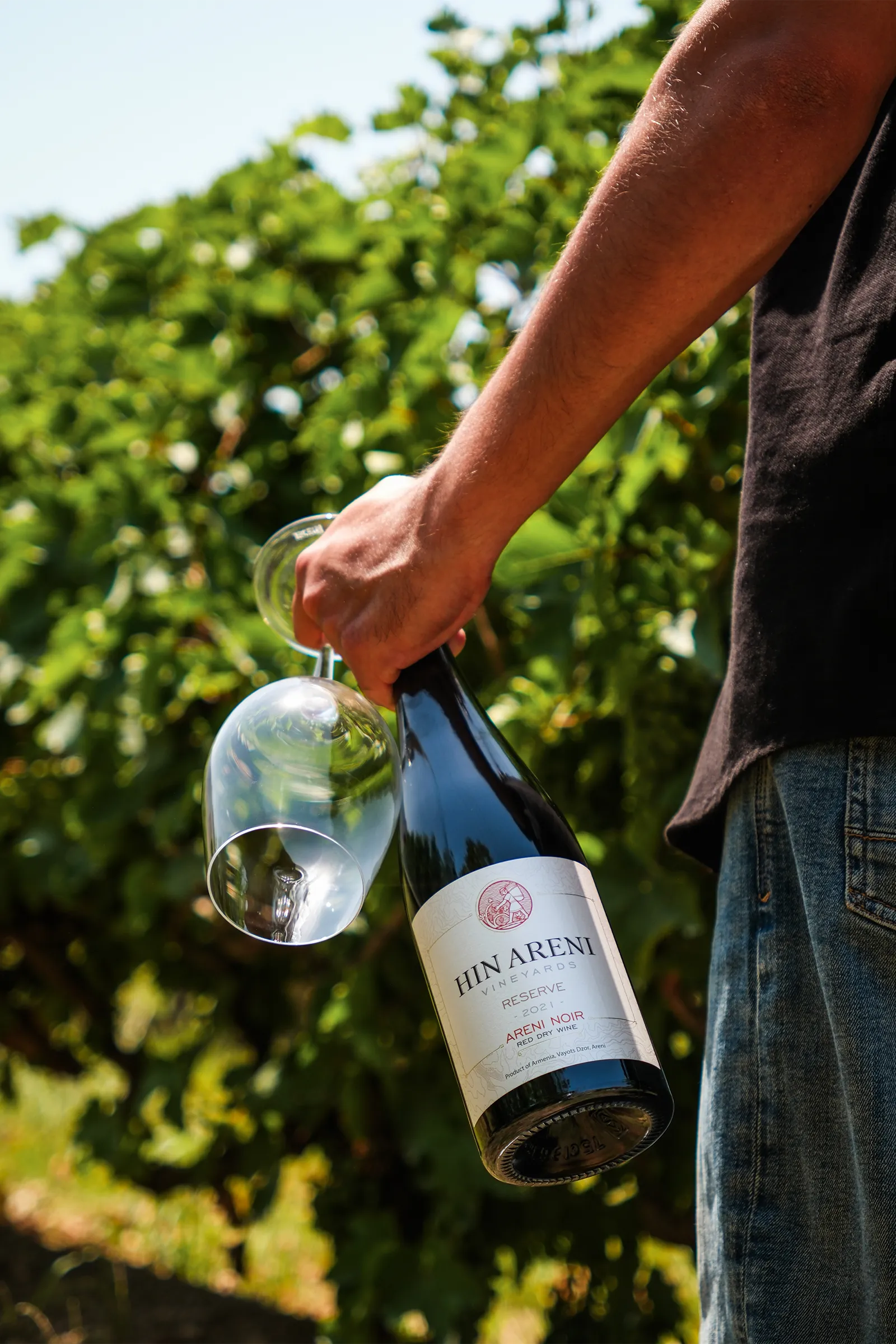
Areni village wines are worth tasting even if you skip the cave. The Areni grape variety — grown only in this valley — produces wines unlike anything made elsewhere. Local wineries along the village road offer tastings of both the wine and Armenian brandy. This is a 20–30 minute stop on the way to or from Noravank, and one that most visitors appreciate more than they expect to.
Practical note: The cave closes earlier than the monastery — check current hours in advance. The cave entrance is on the right side of the road leading into the Noravank gorge; don’t miss it on the way back.
Suggested Day Itinerary
08:30 — Depart Yerevan
09:15 — Photo stop on the approach road (5 min)
09:20 — Khor Virap Monastery (60 min)
10:30 — Drive toward Areni through the Ararat Valley (1 hr)
11:30 — Areni Cave or wine tasting in the village (30–45 min)
12:15 — Drive into the Noravank gorge
12:30 — Lunch at a roadside restaurant near the gorge entrance
13:30 — Noravank Monastery (60–75 min)
15:00 — Return drive to Yerevan (1.5–2 hrs)
17:00 — Arrive Yerevan
This keeps Khor Virap in the morning when Ararat is clearest, and Noravank in the early-mid afternoon — both sides of midday avoid the worst summer heat.
Where to Eat?
There are no restaurants inside either monastery complex. Options are concentrated at two points on the route:
Near Khor Virap: A handful of small cafés and food stalls operate in the Pokr Vedi village just before the monastery approach road. Simple Armenian food, cold drinks. Not destination dining, but fine for a quick breakfast or snack.
Near Noravank: Several restaurants and guesthouses line the road just before the gorge entrance — look for them in Areni village and on the approach to the canyon. These serve proper sit-down Armenian meals: khorovats, trout, dolma. Quality is consistent and prices are low. This is the right place for a proper lunch on the route.
Best Time to Visit
Spring (April–June): The Ararat Valley is green, flowers cover the roadside fields, and the mountain tends to be clear. Temperatures are comfortable. The drive south from Yerevan is particularly beautiful. This is the best season overall.
Autumn (September–October): Clear skies, harvest activity in the vineyards around Areni, and the canyon cliffs at Noravank glow particularly intensely in autumn afternoon light. September is excellent.
Summer (July–August): The Ararat Valley is very hot — among the hottest parts of Armenia. The mountain view from Khor Virap can haze over by mid-morning. Visit both sites as early in the day as possible. Noravank’s canyon provides some shade.
Winter (November–March): The view of Ararat from Khor Virap in snow is genuinely spectacular — the mountain appears white on white and the monastery stands out sharply. Noravank with snow on the red cliffs is remarkable. The drive is manageable. Both sites are open but facilities around them are minimal.
Insider Tips from a Local Guide
The morning light at Khor Virap is not negotiable. Ararat is clearest between 08:00 and 10:30. By early afternoon in summer the mountain is often obscured by heat haze from the valley floor. If you arrive at 13:00, you may see very little of the mountain that is supposed to be the reason for the visit.
Go down into the dungeon. Many visitors see the opening and decide not to bother. This is a mistake. The 6-metre descent into the pit where Gregory spent 13 years in the dark is the most physically immediate experience Khor Virap offers. Take your time at the bottom.
Climb the stairs at Noravank. The external staircase up to the upper chapel is steep, exposed, and requires care — which is exactly why most tour groups don’t go up. The view from the top, and the interior of the upper chapel, are worth the climb. Take it slowly.
Visit the Noravank viewpoint. The walk up the slope behind the complex takes five minutes and gives you the angle that every photo of Noravank uses. Don’t miss it because you’re in a hurry to leave.
Areni wine is serious wine. The Areni grape is indigenous to this valley and produces wines with a character that has no equivalent elsewhere. Even a 20-minute tasting at a village winery adds real depth to the day. It is not an afterthought — it is part of why this region matters.
The canyon road to Noravank changes light throughout the day. If you have flexibility, the cliffs are at their most dramatic in late afternoon as the sun drops toward the canyon walls. If you can time Noravank for 15:00–17:00, the photography improves significantly.
Visiting as Part of a Private Tour from Yerevan
The Khor Virap–Areni–Noravank route is one of the most popular private day tours from Yerevan and one of the most rewarding. The historical weight of Khor Virap, the beauty of the Areni valley, and the drama of the Noravank canyon make it a day that covers more genuine Armenia in one route than almost any other.
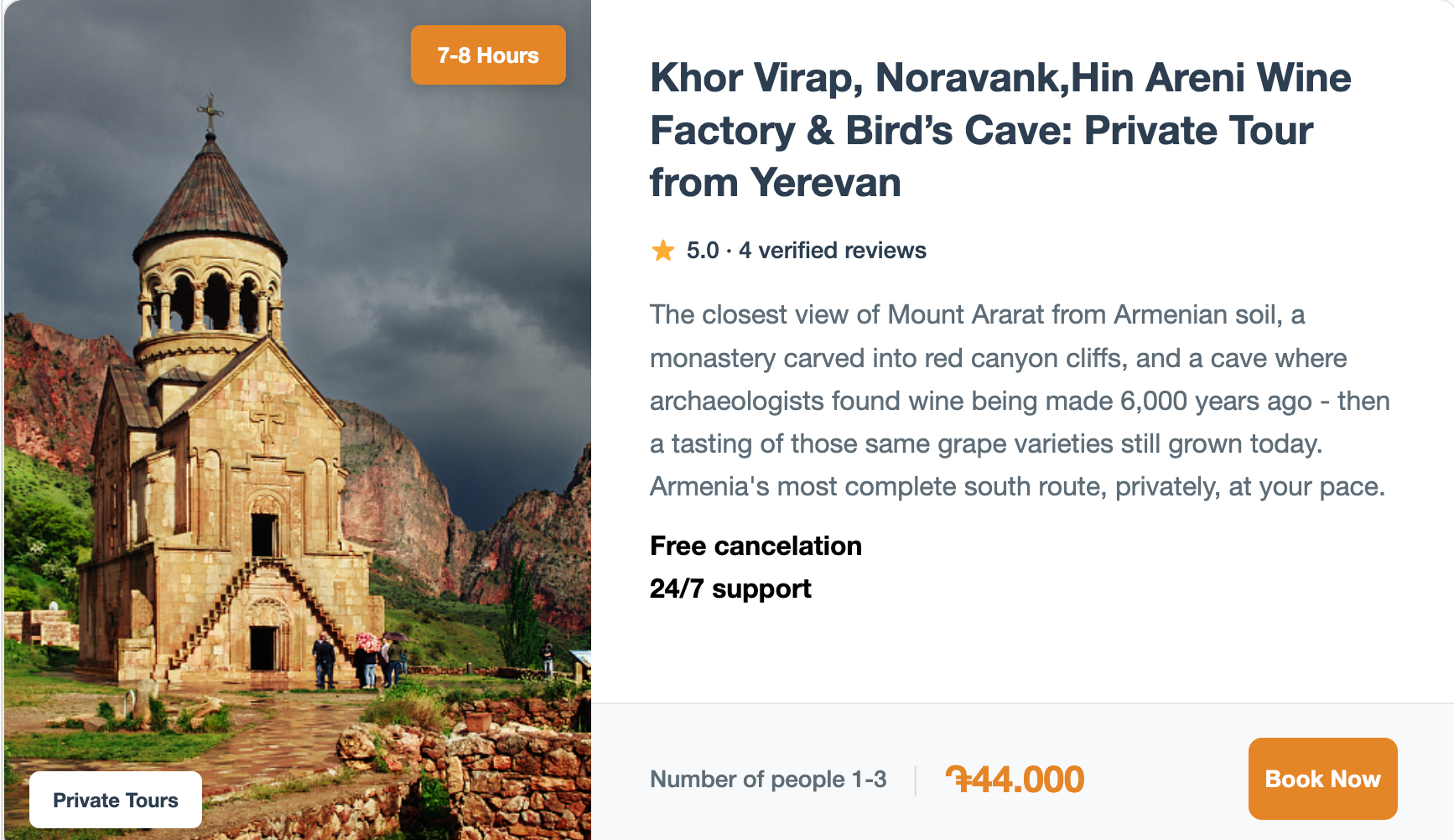
Our private tours cover all three stops with an English or Russian-speaking guide, comfortable vehicle, and full flexibility to add or adjust stops — including the Areni cave, extended wine tasting, or a longer stay at Noravank for sunset light.
→ See our private Khor Virap, Noravank & Areni Wine tour from Yerevan



Comment (0)